Saturday, February 21, 2009

Sad stories of the week


Socks, the Clintons' White House cat, dies, by Kasey Jones, AP.


Socks had reached his late teens — an advanced age for a cat — when reports surfaced in late 2008 that he had cancer and [Bill Clinton's secretary, Betty Currie, Socks's guardian] had ruled out invasive efforts to prolong his life.

"It's not a happy prognosis," presidential historian Barry Landau, a friend of Currie's, said at the time.


Also, Couple divorces but lives in same house to save, ABC News via Yahoo! News. What a mess.

.

Monday, February 16, 2009

Oh, Dakota.


That is how I feel every day.

.

Saturday, February 14, 2009

Girls on Film


How come guys talk so much when they have nothing to say, and girls have plenty to say, but no-one will listen?


Where's Our Stand By Me?, by hortense, Jezebel.

I have always loved My Girl 2. It was set in LA, the city I was obsessed with as a teenager. It starred Austin O'Brien, who was no Macaulay Culkin, but still carried his own in the movie. And it had a self-possessed young female protagonist who made enlightened statements like this:


I don't think anybody should change their names [when they get married]. That way you can always find them when you need them.


Yet now, the supposedly clever, edgy girls we get in movies think that embryos have fingernails and when sparkly vampires tell you to stay away from them, they really like you.

So disappointing and sad. And by "sad", I mean horribly distasteful considering the exponential growth of the number of poverty-stricken people in the United States and across the world.

.

Thursday, February 12, 2009

Musings from a black woman: Oh, really?


The Election of Barack Obama is just the most startling manifestation of a larger trend: the gradual erosion of "whiteness" as the touchstone of what it means to be American. If the end of white America is a cultural and demographic inevitability, what will the new mainstream look like—and how will white Americans fit into it? What will it mean to be white when whiteness is no longer the norm? And will a post-white America be less racially divided—or more so?


The End of White America?, by Hua Hsu, The Atlantic. Super long post ahead. Pace yourselves, readers.

I first heard about this article on Tuesday's episode of The Colbert Report. So much to break down, so little time. To simplify my point, I will say this: white Americans make up 75% of the United States, the majority of the US Senate and the House of Representatives, the majority of Fortune 500 CEOs, and almost all of the main characters (and supporting characters) in US movies and television. One black family in the White House is not going to displace over 225 million people from their centuries-old dominance in this country.


As Bill Imada, head of the IW Group, a prominent Asian American communications and marketing company, puts it: "I think in the 1920s, 1930s, and 1940s, [for] anyone who immigrated, the aspiration was to blend in and be as American as possible so that white America wouldn’t be intimidated by them. They wanted to imitate white America as much as possible: learn English, go to church, go to the same schools."

Today, the picture is far more complex. To take the most obvious example, whiteness is no longer a precondition for entry into the highest levels of public office. The son of Indian immigrants doesn’t have to become "white" in order to be elected governor of Louisiana. A half-Kenyan, half-Kansan politician can self-identify as black and be elected president of the United States.


However, there seems to be a one-black person limit for the US Senate, as well as for the Supreme Court.

Peter Rosenberg, a self-proclaimed "nerdy Jewish kid" and radio personality on New York’s Hot 97 FM—and a living example of how hip-hop has created new identities for its listeners that don’t fall neatly along lines of black and white—shares another example: "I interviewed [the St. Louis rapper] Nelly this morning, and he said it’s now very cool and in to have multicultural friends. Like you’re not really considered hip or 'you’ve made it' if you’re rolling with all the same people."


"Hey, Guillermo."

"What's up, Jamal?"

"Peter Rosenberg says that Nelly says it's very 'cool' and 'in' to have multicultural friends. And if you do have them, then you've made it."

"Made what?"

"I don't know, Guillermo. I still can't get a job with my degree in Sociology."

"It wasn't acceptable before to have multicultural friends?"

"Apparently not."

"But Jamal, we've been friends with Pierre and Hans and Padma and Xochitl for 15 years now, based on our similar interests and personalities, not because it's a trend. I wonder if Peter Goldberg has any multicultural friends."

"I doubt it."


Pop culture today rallies around an ethic of multicultural inclusion that seems to value every identity—except whiteness. "It’s become harder for the blond-haired, blue-eyed commercial actor," remarks Rochelle Newman-Carrasco, of the Hispanic marketing firm Enlace. "You read casting notices, and they like to cast people with brown hair because they could be Hispanic. The language of casting notices is pretty shocking because it's so specific: 'Brown hair, brown eyes, could look Hispanic.' Or, as one notice put it: 'Ethnically ambiguous.'"


Ethnically ambiguous usually translates to "light enough not to scare white people. But not white people like me. I'm one of the good ones! I'm not a racist. I just cater to the alleged racism of other people. Please don't hurt me!" For examples, please see Vanessa in Gossip Girl and Jennifer Beals's character in Flashdance (and Vin Diesel in general), both of whom had conveniently absent parents and no visible siblings, so that ethnic classification was impossible.

Furthermore, I do not understand how in an article about Barack Obama Mr. Hsu can seriously worry about laughable notion that there are fewer opportunities for white actors. Does he not know that every Saturday night, the almost entirely white male cast of SNL has their show open with Fred Armisen, made up in Angelina Jolie's brownface paint, playing a self-identified black man?

"I think white people feel like they’re under siege right now—like it's not okay to be white right now, especially if you’re a white male," laughs Bill Imada, of the IW Group. Imada and Newman-Carrasco are part of a movement within advertising, marketing, and communications firms to reimagine the profile of the typical American consumer. (Tellingly, every person I spoke with from these industries knew the Census Bureau’s projections by heart.)

"There’s a lot of fear and a lot of resentment," Newman-Carrasco observes, describing the flak she caught after writing an article for a trade publication on the need for more-diverse hiring practices. "I got a response from a friend—he's, like, a 60-something white male, and he’s been involved with multicultural recruiting,” she recalls. "And he said, 'I really feel like the hunted. It's a hard time to be a white man in America right now, because I feel like I’m being lumped in with all white males in America, and I've tried to do stuff, but it's a tough time.'"

"I always tell the white men in the room, 'We need you,'" Imada says. "We cannot talk about diversity and inclusion and engagement without you at the table. It's okay to be white!

"But people are stressed out about it. 'We used to be in control! We're losing control!'"


You know what I would tell them? Get over it. I would say it to their faces, too. Boo-hoo. You feel like you're "lumped in with all the white males in America"? Yeah, that's "tough". It's tough to be overrepresented in every boardroom, country club, television screen, movie screen, medical study, advertisement, book and magazine produced in the country you were born in. It's tough having one out of 44 leaders of your country, who has been in control for less than 100 days, not look exactly like you. What do you want, a cookie? Stop being so ignorant, and have some historical and cultural perspective.

“I get it: as a straight white male, I’m the worst thing on Earth,” Christian Lander says. Lander is a Canadian-born, Los Angeles–based satirist who in January 2008 started a blog called Stuff White People Like (stuffwhitepeoplelike.com), which pokes fun at the manners and mores of a specific species of young, hip, upwardly mobile whites. (He has written more than 100 entries about whites’ passion for things like bottled water, “the idea of soccer,” and “being the only white person around.”) At its best, Lander’s site—which formed the basis for a recently published book of the same name (reviewed in the October 2008 Atlantic)—is a cunningly precise distillation of the identity crisis plaguing well-meaning, well-off white kids in a post-white world.


“Like, I’m aware of all the horrible crimes that my demographic has done in the world,” Lander says. “And there’s a bunch of white people who are desperate—desperate—to say, ‘You know what? My skin’s white, but I’m not one of the white people who’s destroying the world.’”


For Lander, whiteness has become a vacuum. The “white identity” he limns on his blog is predicated on the quest for authenticity—usually other people’s authenticity. “As a white person, you’re just desperate to find something else to grab onto. You’re jealous! Pretty much every white person I grew up with wished they’d grown up in, you know, an ethnic home that gave them a second language. White culture is Family Ties and Led Zeppelin and Guns N’ Roses—like, this is white culture. This is all we have.”


Lander’s "white people” are products of a very specific historical moment, raised by well-meaning Baby Boomers to reject the old ideal of white American gentility and to embrace diversity and fluidity instead. (“It’s strange that we are the kids of Baby Boomers, right? How the hell do you rebel against that? Like, your parents will march against the World Trade Organization next to you. They’ll have bigger white dreadlocks than you. What do you do?”) But his lighthearted anthropology suggests that the multicultural harmony they were raised to worship has bred a kind of self-denial.


1. Christian Lander is Canadian; I thought we were talking about the United States.

2. "All" Christian Lander has is a multiple book deal, along with multiple mentions in popular, respected magazines like The Atlantic, or lesser known publications like The Boston Globe or The Los Angeles Times or The New York Times or CNN.

So, what's your damage, Heather?


Matt Wray, a sociologist at Temple University who is a fan of Lander's humor, has observed that many of his white students are plagued by a racial-identity crisis: "They don’t care about socioeconomics; they care about culture. And to be white is to be culturally broke. The classic thing white students say when you ask them to talk about who they are is, 'I don't have a culture.' They might be privileged, they might be loaded socioeconomically, but they feel bankrupt when it comes to culture … They feel disadvantaged, and they feel marginalized. They don’t have a culture that’s cool or oppositional." Wray says that this feeling of being culturally bereft often prevents students from recognizing what it means to be a child of privilege—a strange irony that the first wave of whiteness-studies scholars, in the 1990s, failed to anticipate.

"Culture" doesn't pay the rent or put food on my family. Additionally, not all white people are culturally broke, privileged or loaded socioeconomically. Matt Wray should speak with Rochelle Newman-Carrasco's white male friend, because as that friend told us, white people are not all the same.


. . . we aspire to be post-racial, but we still live within the structures of privilege, injustice, and racial categorization that we inherited from an older order. We can talk about defining ourselves by lifestyle rather than skin color, but our lifestyle choices are still racially coded. We know, more or less, that race is a fiction that often does more harm than good, and yet it is something we cling to without fully understanding why—as a social and legal fact, a vague sense of belonging and place that we make solid through culture and speech.

But maybe this is merely how it used to be—maybe this is already an outdated way of looking at things. "You have a lot of young adults going into a more diverse world," [Karl Carter, of Atlanta’s youth-oriented GTM Inc. (Guerrilla Tactics Media)] remarks. For the young Americans born in the 1980s and 1990s, culture is something to be taken apart and remade in their own image. "We came along in a generation that didn't have to follow that path of race," he goes on. "We saw something different." This moment was not the end of white America; it was not the end of anything. It was a bridge, and we crossed it.


It would be nice if that bridge was available to the many colorful students who are stuck in failing schools that were made worse by No Child Left Behind, or if it were available to those kids who can't escape the institutional poverty and/or racism that plagues them every day.

I leave you with a group of individuals on their own bridge, from Gs to Gents.

.

Tuesday, February 10, 2009

Somebody was in Emergency, Somebody just got out of Jail


I considered reserving judgment about this situation until more evidence was in. However, as I read through the comments on Defamer and Racialicious and Jezebel and other blogs, I thought of the West Wing episode that inspired the name of this post.

Rihanna had to be hospitalized due to her injuries, including a black eye as well as "a swollen split lip and two red and purple contusions on either side of her forehead." Chris Brown is free after posting bail, with no reported injuries. Unless Rihanna fell out of Chris's car during a high speed chase, rolled down a hill and waved her fingers at a hungry animal, I don't know what other evidence is necessary to determine that something very wrong happened early Sunday morning.

I never downloaded or purchased any Chris Brown songs, so I don't have any to delete or destroy.

.

Monday, February 09, 2009

The best part of The L Word


Love love love. Someday, I will be able to afford my own kid.

The worst part of The L Word? Shenny. That couple is made of Fail. I don't even have Showtime anymore, but the thought of Jenny and Shane getting together still makes me cringe.

.

Saturday, February 07, 2009

My favorite part of Super Bowl Sunday


It was Super Special indeed. Thank you, Sarah Haskins!

The video is 48 minutes and nine seconds long, so pace yourself.

.

"You shouldn't end a sentence with a preposition at."


I loved this episode! My favorite quote of many:


Tracy, regarding the new former-investment-banker interns: "I have a rep to maintain. If I can't keep up with a bunch of Wall Street frat boys . . . Uh oh. Here come the roofies."


And one more!


Tracy: "So if I'm going to keep my hilarious reputation, these interns got to go!"

Kenneth: "But where? They don't know how to do anything. And there are no jobs left on Wall Street."


Hee! Also, more Jonathan please!

.

Saturday, January 31, 2009

Black history is Everyone's history.


Thank you, VH1. And thank you, Ray J:


He's a multi-platinum singer/songwriter? Really?

.

Tuesday, January 27, 2009

"The Republicans are going to get clobbered by African Americans?"


Yes, Stephen. You should be afraid of black people.

.

Saturday, January 24, 2009

Snowmen (and snowwomen) are round and lovable.


They don't need the Special K challenge. So step off, kid.

That little girl needs to watch some Sarah Haskins before she starts dieting in five years.

.

What it feels like for a girl


As you readers know, I love The Office. It is Thursday night appointment television. As you also know, I am most openly critical of the things that I love. Hence, my feelings about this week's episode, "Prince Family Paper." Half of the episode was an homage to the failed ABC series, Are You Hot?. While Michael and Dwight were away, the rest of the office debated whether Hilary Swank was hot or not. This took up their entire day.

For many viewers, I'm sure this seemed like a yet another typical office discussion that went on for too long. For me, it was yet another reminder of the impossible standards by which even highly successful women are judged. It also reminded me that all of the writers on The Office are probably male (and white) [Edit, 1/24/2009: Except for Mindy Kaling. Thanks, molecularshyness!], which results in most of the stories centering around average-looking guys judging and hooking up with women waaay out of their league (I'm looking at you, Kevin).

Hilary Swank has won two Oscars. Yet her worth, as described by one of America's most influential television programs, comes down to whether she is hot or not. I have never heard anyone question or even mention the hotness quotient of the similarly-accoladed Tom Hanks, Jack Nicholson or Dustin Hoffman (who still gets to star in movies with a woman 20 years younger than he is). Instead, I get to hear the most powerful woman in the world worry about the fact that she currently weighs 200 pounds, and let that fact overshadow her billion-dollar empire or her hand in electing Barack Obama to the presidency of the United States.

The episode also reminded me of a conversation I had this week that went like this:


Gentleman 1: Have you met Sally yet?

Gentleman 2: No, I still haven't met her. Everyone keeps telling me about her.

Me: She was at the party last Friday.

Gentleman 2: That's what I heard.

Gentleman 1: She is bangin'.

Gentleman 2: I know. That's what I keep hearing.

Me: She's a nice lady. And she has a very successful career.

Gentleman 2: I can't tell anything from that. But "bangin'" I understand.


Lovely.

Before that conversation, I was having a happy, confident day. I was still rolling, jazzed from one of my friends stating that if she were a gentleman, she would date me because I'm nice, knowledgeable, kindhearted and friendly. I refrained myself from joking than we should get a timeshare in Provincetown and instead said, "thank you." I told her that wish more guys would appreciate those qualities in me and share her sentiments, but all they care about is hotness. She said, "No, you will be successful with gentlemen." Since she was so certain, I believed her for a few hours and thought I was so cool. Now, not so much anymore. Even in an era where I can realistically aspire to be President. Or rather, first lady.

It doesn't matter if you're Fred Savage's dorky character on Working or the super popular Bright from Everwood. All that matters to guys, regardless of orientation, is hot. Then when they get hot, they're disappointed because they also got shallow. What did you expect, doofus? Like I'm supposed to have sympathy for your poor choices? I don't think so. Or, in the words of Cher Horowitz, as if.

.

Thursday, January 22, 2009

Still my #1 blog crush:


With my luck, Mr. Smooth is probably married with two kids. Because that's how I roll. :|

Don't worry, I still heart you, too, J G-L, aka, the only reason to watch this summer's G.I. Joe.

If only Mr. Samberg had a blog.

.

Wednesday, January 21, 2009

"Yes, I thought I'd live to see this day."


I thought I had made that clear with my Morgan Freeman references. So you can stop asking us that question any time now.

.

Tuesday, January 20, 2009

I was considering live-blogging the inauguration.


Then I realized I had no concept of time, or proximity to a computer and a television set during the event. Oh well.

For some reason, I now want to watch a marathon of Extras. This is largely due to my viewing the Ricky Gervais episode of Inside the Actors Studio last night. So.

Hooray for the USA! And for round, British comedians.

.

Monday, January 19, 2009

Sunday, January 18, 2009

"Is this too close?" "Is that inappropriate?"


Yes. And yes. Those two need to meet Chet from The Real World: Brooklyn:


.

Saturday, January 17, 2009

I can finally talk with most of my friends.


How did we communicate before Barack Obama? Oh yeah, through television.

Talk About Race? Relax, It’s O.K., by Sarah Kershaw, New York Times via Jezebel.


. . . over the last few months, both Mr. Rice and Ms. Knox, who live in Washington, have been struck by the slight easing of these examples of what psychologists describe as "interracial anxiety" between blacks and whites. That is because there is a now an omnipresent icebreaker: Barack Obama.

"There’s a more readily accessible conduit into the conversation about race if it begins with Barack Obama," said Mr. Rice, the executive director of the Association of Public-Safety Communications Officials — International, a professional law enforcement group. "In my experience over the last few months, it’s easier because it’ll begin with who he is, the differences between his parents, what he had to deal with." . . .

. . . "Before Obama, there was always this thing — 'He's a black doctor,'" Mr. Jackson said. “But now I’m going to be a physician who also happens to be black. That’s become the perception now, which is really nice." . . .

. . . On the morning after the election, Kristin Rothballer, 36, who lives in San Francisco, kissed her female partner goodbye on the train while commuting to work. A black woman who sat down next to her turned and said she was sorry that Proposition 8, the amendment to ban gay marriage in the state, looked like it was going to pass.

"We grabbed hands," Ms. Rothballer recalled. "And I said, 'Well, I really want to congratulate you because we have a black president and that’s amazing.'"

"Our conversation then almost became about the fact that we were having the conversation," she said.

Something moved her to apologize to the black woman for slavery. [Readers, do not do this.]

"For two strangers riding a train to Oakland to have that conversation about race, it wouldn't have been possible if Obama hadn't been elected," she said. 'I always felt open with my colleagues, but to say to a stranger on the train, 'Hey, I’m sorry about slavery,' that just doesn’t happen."


It's too bad that with Bill Richardson gone, I still can't talk with my Latino friends. I doubt I'll ever be able to talk with my Asian friends, or to my friends who don't fit into the ethnic roles designated by the U.S. Census.

Also, this article was in the Fashion & Style section of the New York Times. I guess black is the new black. Oy.

.

Tuesday, January 13, 2009

My new favorite song:


It's a better video than Leavin'.

.

Monday, January 12, 2009

A bundle of contradictions


I like to encourage my friends, acquaintances and relative strangers to take classes at the gym like I do. Like Step, Kickboxing, Body Sculpting, Hip Hop, Yoga.

Yet when New Year's rolls around, the inner conflict begins. New people with clichéd resolutions to eat less and exercise more fill the studio to the bursting point. With so many people punching and kicking in such a small space, I often fear taking a Puma to the head. I resent all these fairweather athletes taking up room in my regular classes.

Then one by one, sometimes two at a time, these new people either get bored or frustrated by the complex and demanding combinations. So they leave. And I feel bad. I don't like when people feel discouraged. I want to tell them, "hang in there, kid."

However, once they leave, there is a lot room to move around. So.

.

My favorite Target commercial:


More Princess Unicorn suggestions are welcome!

.

Friday, January 09, 2009

What I have to look forward to

[photo by Anne Terada]

if I marry a Beatle or a President-elect or an adulterous senator or a former MBA in charge of Operations:

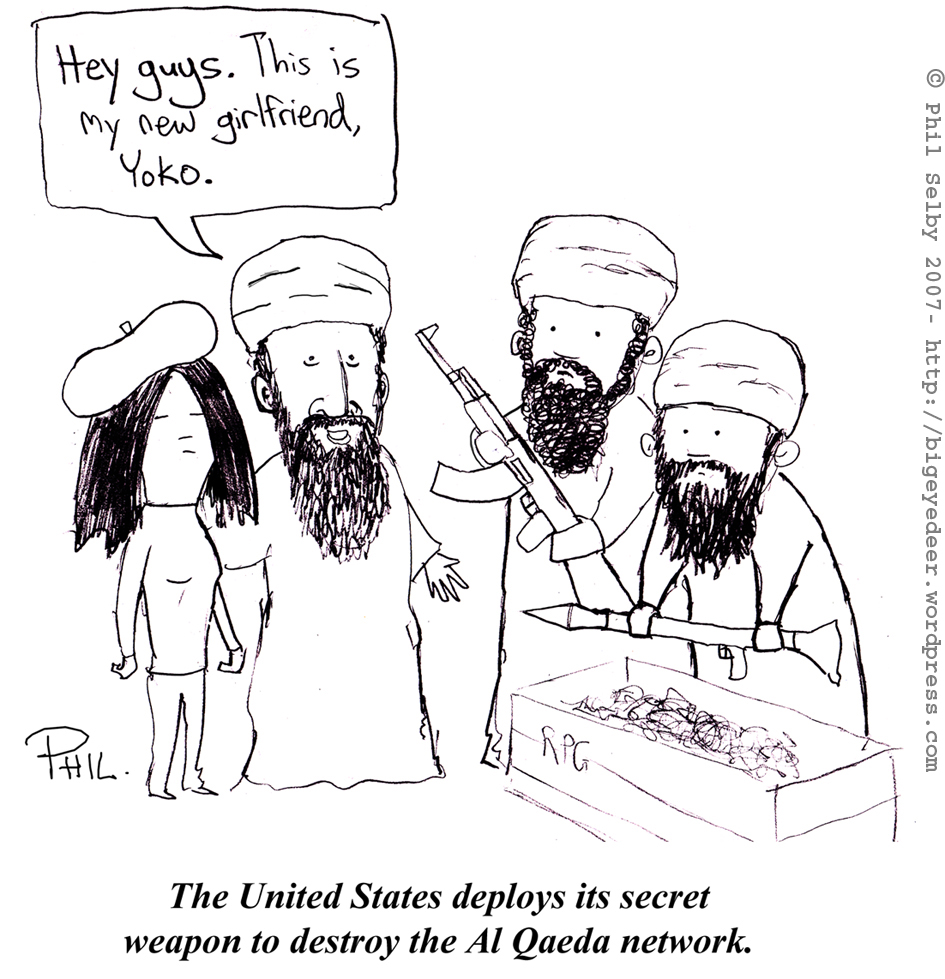
Yoko Ono: A Feminist Analysis (Addendum: Just Like Starting Over), by Cara at The Curvature.


The kind of hate we see for Yoko, we still see today for other powerful women married to men of great influence. Hillary Clinton gets the Yoko treatment when people claim that her marriage to Bill is all a sham intended to bolster her political career, and when Bill was derided for working with Hillary on policy issues. Michelle Obama gets the Yoko treatment when people suggest that she has too much influence over Barack’s decisions, up to and including pushing those she doesn’t like out of the picture, and when Barack is criticized for having a wife with her own opinions. Everything old is new again . . .

. . . And what of her own work? In virtually every article I’ve ever read about one of her art shows or peace initiatives, she is either discussed in relation to her late husband, or defended with the proclamation that she is more than John Lennon’s widow. How absurd that this point need be hammered home.


Also, that chessboard with all white pieces and squares is not only a replica of one of Yoko Ono's most famous works. It is also a cake. Cake!

.

"Am I integrating this school?"


Hee! And, so sad. :(

.

Thursday, January 08, 2009

I'm not "aggressive",


but I do give off a "nerdy vibe." I would totally date a small, clever UN officer, and I can find the Brooklyn Bridge.

.

Because boys need even more attention.


Disney to target boys with rebranded cable channel, by Dawn C. Chmielewski at LA Times.


The entertainment giant plans to relaunch Toon Disney as Disney XD [on Friday, February 13, at 12 midnight], which will be aimed at boys ages 6 to 14.

. . . the Disney Channel has struggled for years to find the right programming formula to lure boys, who tend to gravitate to Viacom’s Nickelodeon and Time Warner’s Cartoon Network – that is, when they’re not spending time playing video games. The Disney Channel’s popular live-action shows, from its early tween phenomenon, “Lizzie McGuire,” through its current pop-culture sensation, “Hannah Montana,” mainly attract girls. Efforts to bring in more boys, through male-led series such as “Even Stevens” or “The Suite Life of Zack and Cody,” still haven’t succeeded enough to close the gender gap between female and male viewers. Animation, traditionally a draw for boys, has been a struggle for Disney Channel, although its newest series, “Phineas and Ferb,” appears to be building a strong male following. But so far, the network has failed to produce a blockbuster to compete with Nickelodeon’s “SpongeBob SquarePants;” or match the guy-centric focus of Cartoon Network, which one ad-buyer described as the “ESPN” of animation.

"You’re fighting the brand perception, the very, very strong brand equity that’s been in the marketplace for many, many years," Kahn said of the Disney Channel. "It would almost require a completely separate effort to reach tween boys, with a completely different name somehow associated with the Disney property, to reach these tween males."

None of this is news to Ross, who, with his executive team, spent more than a year with focus groups pondering the eternal verities: “What do boys want?”

The answer, perhaps not surprisingly, is that boys want it all. "What we heard, loud and clear, is they expect from Disney this broad array," Ross said, with programs running the gamut from animation to action-adventure to comedy. "They expect from Disney the whole thing, including movies." In short, tween boys are looking for more than a show or two wedged in the midst of the musical theater-inspired programs that have come to define the Disney Channel. They want, Disney says, a channel they can call their own.

"They want a place, essentially a headquarters for them where their favorite content exists, that has this broad array of shapes and sizes and tenors and complexities, and treats them with the respect that Disney Channel treats all kids, and the girls are fanatical about," Ross said.


So tiny girls get The Disney Channel, with many shows whose casts are actually more than 50% male. And tiny boys get Nickelodeon, Cartoon Network and Disney XD, with shows whose casts are almost 100% male. Yes we can! If we are tiny and white and male!

.

Wednesday, January 07, 2009

I don't even watch Avatar,


but this sounds like standard Hollywood procedure:


Airbending Racism in The Last Airbender
, at A Chatterbox.


Recently, an announcement came out regarding the casting for the “The Last Airbender” movie, directed by M. Night Shyamalan and based on the cartoon series “Avatar: The Last Airbender“. You can find the post with the announcement and pictures of the proposed actors here.

Now, even if you don’t know much about the show or were unaware that it was heavily influenced by a variety of Asian cultures, you could at least pick up on the fact that while the drawn pictures of the sister and brother pair, Katara and Sokka, show them as being brown skinned, the actors picked for them are very, very white.


and

M. Night, say it isn't so, by nojojojo at The Angry Black Woman.


. . . one of the things that hooked me about this show was that it was set in an all-Asian world. And it wasn’t fucked up. OK, let me clarify. You know how usually, when there’s an Asian character in an American TV show, he (or more frequently she) ends up as the martial arts master, the (white) hero’s submissive love interest, the dragon lady vamp, or the magical elderly person dishing out nonsensical proverbs and occasionally a can of whoopass? The thing is, all of these stereotypes are present in Avatar to some degree. But because the whole world is Asian, they’re lost in a sea of non-stereotypical, non-exoticized, perfectly normal human beings. How amazing is that? Not only that, but Avatar actually depicts different Asian ethnicities. Though this is a fantasy world, there are clear allusions to the Inuit, Koreans, Mongols, Tibetans, several flavors of southeast Asian, various Indians, and more. The Chinese- and Japanese-analogues of the story actually come in several varieties (Earth Kingdom and Fire Kingdom, Kyoshi warriors, etc.) . . .

. . . I’m sick of this. I know it happens all the goddamn time, but I’m sick of it. This persistent belief on Hollywood’s part that brown people “don’t sell” has to change. I would’ve expected better from M. Night, who is Asian himself, but as we all know, being a PoC doesn’t make one immune to white supremacist thinking, or stupidity . . .


I like "Leavin'" more the next person, but I couldn't get through an entire episode of Summerland. If Jesse McCartney wasn't compelling enough to keep my interest in a WB series (and I watched Young Americans . . . and Pepper Dennis), I don't think he has the talent to convince me that he is both Asian and a skilled martial artist. But since he fits the teen idol mold, Jesse (and others like him, winky wink) gets the part, regardless of his actual qualifications.

.

I blog in my pajamas.


Don't you?

.

Sunday, January 04, 2009

I was thinking about that, too!


Yoko Ono: A Feminist Analysis (Introduction: Oh Yoko!), by Cara at The Curvature via Feministe.

. . . the treatment of Yoko Ono is still relevant to our understanding of art, relationships and a woman’s place in society.

Yoko Ono’s name is tossed around as an insult, sometimes "jokingly," sometimes really and truly hatefully. Any woman who dates a male band member and expects to be treated like a person, or any woman who is seen to in some way cause a change in a male artist of any kind, is particularly at risk of being called “Yoko.” To a lesser extent, so is any woman who expects to be given equal consideration as her partner and her partner’s friends friends. Why is it an insult, exactly? Well, because “everyone” hates Yoko Ono. She’s a mentally unbalanced, scheming, money-grubbing, castrating bitch. Oh, and she broke up the Beatles. Or so they say . . .

. . . If you actually take the time to read Beatles history, you’ll see pretty clearly that the cracks in the band were showing for some time before John Lennon even met Yoko. John was growing away from the Beatles musically, struggling with drug addiction and with the insecurity he seemed to feel in varying degrees throughout most of his life, and was therefore lashing out and pulling away from the group. Paul McCartney was making a power grab for control of the band, one that he was winning and John felt powerless to stop — and while John had a tendency to be nasty to the people closest to him, Paul had a tendency to be extremely condescending and controlling. George Harrison was resentful of John and (especially) Paul’s refusal to take his songwriting and musicianship seriously — even though despite being neither the greatest songwriter or vocalist in the group, he was absolutely fucking brilliant. Ringo Starr never had a serious problem with any of the other Beatles, but was feeling incredibly marginalized within the band and distraught over the disharmony.


Poor Ringo. :( I see him as the undersung Beatle.


The other thing that changed my mind was John himself, and his persistent, repeated earnestness in professing that he wanted out of the Beatles long before Yoko and she only gave him the strength to do it; not to mention his proclamations of happiness and rightful insistence that anyone who hated Yoko and didn’t respect their relationship certainly didn’t love him or have his best interests at heart. And realizing that Yoko wasn’t to blame for the Beatles breakup makes you ask a question. Why does the myth persist?


Why indeed. Rebel Grrrl mentions the old SAT-style analogy "Men:Heroes as Women:villains". I agree with that in so many ways. Cara is bringing the deepness with her Yoko Ono posts.

.

I would report on more Princess Unicorn stories if I could,


but these provocative stories just jump out at me:

Katrina's Hidden Race War
, By A.C. Thompson, The Nation via Feministing.

. . . During the summer of 2005 Herrington was working as an armored-car driver for the Brink's company and living in a rented duplex about a mile from Algiers Point. Katrina thrashed the place, blowing out windows, pitching a hefty pine tree limb through the roof and dumping rain on Herrington's possessions. On the day of the shooting, Herrington, Alexander and Collins were all trying to escape the stricken city, and set out together on foot for the Algiers Point ferry terminal in the hopes of getting on an evacuation bus.

Those hopes were dashed by a barrage of shotgun pellets. After two shots erupted, Collins and Alexander took off running and ducked into a shed behind a house to hide from the gunmen, Alexander tells me. The armed men, he says, discovered them in the shed and jammed pistols in their faces, yelling, "We got you niggers! We got you niggers!" He continues, "They said they was gonna tie us up, put us in the back of the truck and burn us. They was gonna make us suffer.... I thought I was gonna die. I thought I was gonna leave earth."

Apparently thinking they'd caught some looters, the gunmen interrogated and verbally threatened Collins and Alexander for ten to fifteen minutes, Alexander says, before one of the armed men issued an ultimatum: if Alexander and Collins left Algiers Point and told their friends not to set foot in the area, they'd be allowed to live.

Meanwhile, Herrington was staring at death. "I was bleeding pretty bad from my neck area," he recalls. When two white men drove by in a black pickup truck, he begged them for help. "I said, Help me, help me--I'm shot," Herrington recalls. The response, he tells me, was immediate and hostile. One of the men told Herrington, "Get away from this truck, nigger. We're not gonna help you. We're liable to kill you ourselves." My God, thought Herrington, what's going on out here?

He managed to stumble back to a neighbor's house, collapsing on the front porch. The neighbors, an African-American couple, wrapped him in a sheet and sped him to the nearest hospital, the West Jefferson Medical Center, where, medical records show, he was X-rayed at 3:30 pm. According to the records, a doctor who reviewed the X-rays found "metallic buckshot" scattered throughout his chest, arms, back and abdomen, as well as "at least seven [pellets] in the right neck." Within minutes, Herrington was wheeled into an operating room for emergency surgery.

"It was a close-range buckshot wound from a shotgun," says Charles Thomas, one of the doctors who operated on Herrington. "If he hadn't gotten to the hospital, he wouldn't have lived. He had a hole in his internal jugular vein, and we were able to find it and fix it."

After three days in the hospital, which lacked running water, air conditioning and functional toilets, Herrington was shuttled to a medical facility in Baton Rouge. When he returned to New Orleans months later, he paid a visit to the Fourth District police station, whose officers patrol the west bank, and learned there was no police report documenting the attack. Herrington, who now has a wide scar stretching the length of his neck, says the officers he spoke with failed to take a report or check out his story, a fact that still bothers him. "If the shoe was on the other foot, if a black guy was willing to go out shooting white guys, the police would be up there real quick," he says. "I feel these guys should definitely be held accountable. These guys had absolutely no right to do what they did." . . .


There's more!


. . . militia member Wayne Janak, 60, a carpenter and contractor, is more forthcoming with me. "Three people got shot in just one day!" he tells me, laughing. We're sitting in his home, a boxy beige-and-pink structure on a corner about five blocks from Daigle's Grocery. "Three of them got hit right here in this intersection with a riot gun," he says, motioning toward the streets outside his home. Janak tells me he assumed the shooting victims, who were African-American, were looters because they were carrying sneakers and baseball caps with them. He guessed that the property had been stolen from a nearby shopping mall. According to Janak, a neighbor "unloaded a riot gun"--a shotgun--"on them. We chased them down."

Janak, who was carrying a pistol, says he grabbed one of the suspected looters and considered killing him, but decided to be merciful. "I rolled him over in the grass and saw that he'd been hit in the back with the riot gun," he tells me. "I thought that was good enough. I said, 'Go back to your neighborhood so people will know Algiers Point is not a place you go for a vacation. We're not doing tours right now.'"

He's equally blunt in Welcome to New Orleans, an hourlong documentary produced by the Danish video team, who captured Janak, beer in hand, gloating about hunting humans. Surrounded by a crowd of sunburned white Algiers Point locals at a barbeque held not long after the hurricane, he smiles and tells the camera, "It was great! It was like pheasant season in South Dakota. If it moved, you shot it." A native of Chicago, Janak also boasts of becoming a true Southerner, saying, "I am no longer a Yankee. I earned my wings." A white woman standing next to him adds, "He understands the N-word now." In this neighborhood, she continues, "we take care of our own."

Janak, who says he'd been armed with two .38s and a shotgun, brags about keeping the bloody shirt worn by a shooting victim as a trophy. When "looters" showed up in the neighborhood, "they left full of buckshot," he brags, adding, "You know what? Algiers Point is not a pussy community."

Within that community the gunmen enjoyed wide support. In an outtake from the documentary, a group of white Algiers Point residents gathers to celebrate the arrival of military troops sent to police the area. Addressing the crowd, one local praises the vigilantes for holding the neighborhood together until the Army Humvees trundled into town, noting that some of the militia figures are present at the party. "You all know who you are," the man says. "And I'm proud of every one of you all." Cheering and applause erupts from the assembled locals.

Some of the gunmen prowling Algiers Point were out to wage a race war, says one woman whose uncle and two cousins joined the cause. A former New Orleanian, this source spoke to me anonymously because she fears her relatives could be prosecuted for their crimes. "My uncle was very excited that it was a free-for-all--white against black--that he could participate in," says the woman. "For him, the opportunity to hunt black people was a joy."

"They didn't want any of the 'ghetto niggers' coming over" from the east side of the river, she says, adding that her relatives viewed African-Americans who wandered into Algiers Point as "fair game." One of her cousins, a young man in his 20s, sent an e-mail to her and several other family members describing his adventures with the militia. He had attached a photo in which he posed next to an African-American man who'd been fatally shot. The tone of the e-mail, she says, was "gleeful"--her cousin was happy that "they were shooting niggers." . . .

I support peace.


Israeli troops and tanks slice deep into Gaza, by Ibrahim Barzak and Jason Keyser, AP via Yahoo! News.

Thousands of Israeli troops backed by tanks and helicopter gunships surrounded Gaza's largest city and fought militants at close range on Sunday, in the first full day of an overwhelming ground offensive in the coastal territory.

Israel said it has inflicted a heavy blow against Hamas as it expands a weeklong offensive meant to stop rocket fire on southern Israel. But spiraling civilian casualties among Palestinians fueled an international outcry, even as the U.S. blocked approval of a U.N. Security Council statement Saturday night calling for an immediate cease-fire.

Israel's ground forces moved in after nightfall Saturday following hours of intense, fiery artillery shelling to clear the way, and Hamas warned that its fighters would turn Gaza into an Israeli "graveyard."

On Sunday, Israeli soldiers continued to fight primarily in open areas in the launching zones used by Gaza's militants to send rockets raining down on Israeli cities. As the troops in three brigade-size formations moved in, residents of those Israeli cities began emerging from bomb shelters in hopes that the rocket fire would taper off.

Backing up the troops, mobile artillery units fired shells that exploded in veils of white smoke over Gaza's urban skyline. Tanks pushed south of Gaza City as deep as the abandoned settlement of Netzarim, which Israel left along with other Israeli communities when it pulled out of Gaza in 2005.

That effectively cut off Gaza City, the territory's largest population center with some 400,000 residents, from the rest of Gaza to the south.


The article continues:


Gaza officials said at least 31 civilians were killed in the onslaught, which also continued from the air.

At one hospital, in the northern village of Beit Lahiya, medics carrying three injured children in their arms rushed them to treatment. One of the children had a blood-soaked bandage wrapped around his head and covering his eyes.

An Israeli airstrike close to Gaza City's main market showered the area with shrapnel, killing three children, all of them siblings, medics said. Militants were using empty land next to the Firas market to fire rockets.

Israeli forces killed dozens of armed Hamas gunmen, an army statement said, but Gaza officials could confirm only a handful of dead fighters — in part because rescue teams could not reach the battle zones.

The new deaths brought the death toll in the Gaza Strip to more than 512 since Dec. 27. The tally is based on figures from the U.N. and Palestinian health officials as well as a count by The Associated Press.

One Israeli soldier died — the first to be killed in the ground operation — and 30 others were wounded, some of them in heavy exchanges of fire near the militant stronghold of Jebaliya, a town on Gaza City's northern outskirts, the army said. Heavy Israeli casualties could undermine what has so far been overwhelming public support for the operation.

Condemnation of Israel's ground operation poured in from around the Middle East and Europe.

"It is absolutely necessary that the violence has to stop," said EU External Relations Commissioner Benita Ferrero-Waldner.


And then:


Support for Israel remained firm from U.S. officials, who squarely blame Hamas.

Vice President Dick Cheney said Israel "didn't seek clearance or approval from us, certainly" before thousands of soldiers pushed into Gaza after nightfall on Saturday.

Sens. Harry Reid and Dick Durbin — the top two Democrats in the chamber — and Senate Republican leader Mitch McConnell all described Israel's actions as understandable. "I think what the Israelis are doing is very important," Reid said. "I think this terrorist organization, Hamas, has got to be put away. They've got to come to their senses."


I don't understand how any of this is "understandable". I don't understand why U.S. officials are taking sides. I don't understand how to "put away" a "terrorist organization" by killing civilians, including children. If someone is reading this who knows more about this almost century-long situation, please explain it to me.

.

Tuesday, December 23, 2008

It's okay, he was 21.


I am currently crushing on Matthew Broderick in WarGames. He was a computer dork who liked hacking into undersecured mainframes; what's not to love? I watched part of the movie this morning, but I didn't get to finish it. Barry Corbin was a lot nicer in One Tree Hill, and Ally Sheedy was a lot more interesting in The Breakfast Club. Well, she was until Molly Ringwald turned her into a Soc for Emilio Estevez. Is Emilio still working? Oh. The things you do for family.

.

Sunday, December 21, 2008

Not in my house,


not around my kids.

The Pink & Blue Project by JeongMee Yoon
, by Sarahh, Apartment Therapy.


. . . The Korean artist's ongoing photographic series explores the links between cultural preferences, gender socialization, and identity through the bedrooms and belongings of various little boys and girls.

The "Pink & Blue Project" overwhelmingly reminds us of how socially ingrained the two colors are with set genders. Looking at Yoon's photos makes us want to send something blue to our friend and family's little daughters and something pink to their sons . . .


This is why I give my nieces and nephews non-gender-specific gifts. This is also why I won't be telling my family and friends the genders of my future babies until they pop out, or arrive, in the case of the acquired ones. I will be raising my kids in the manner of the Fabulous Child named X. My children are going to love their socially-nonconformist mother. And by "love", I mean "be thoroughly embarrassed by".

.

Tuesday, December 16, 2008

Saturday, December 13, 2008

The chicken came first.


On Race and YA Lit, by Neesha Meminger, Racialicious.


. . . years ago when I was submitting my first (admittedly awful) manuscript to agents, some of the nicest rejections I received were accompanied with, “Your novel has much to love, but regrettably, we already have an Asian author for our list.”

Now I understand The Brushoff – I’ve provided plenty of those in my life and do not resent or judge other providers of same. But to be satisfied with ONE author representing an entire continent that consists of countries as varied as Korea, Sri Lanka, Uzbekistan, and Nepal? Seriously?


All you have to do is stroll through the aisles of a bookstore to see that the fantasy, mystery, romance genres are stocked full. And not with fantasy, mystery, or romance by authors of Color. Those, if and when they exist, often get stocked in the African-American, Native-American, Asian-American, Latin-American, or Multicultural sections.


Given the choices that agents, publishers, and major bookstores make about what they acquire and how they promote it, does the market inform what gets published?


Or does what gets published actually inform the market?


It's the latter.

This week I had a related discussion with one of my male colleagues [Hello, and please leave a comment!] about women in television. It is the same argument I have with many male people about the representation of women in American media. Their side usually goes like this:


"I see women in television all the time. There's Lifetime, WE, Oxygen. Men only have Spike. Even though men comprise the leads on almost every scripted and nonscripted series on television, along with almost all the substantial secondary roles, that reflects the demand of the audience. If women demanded more TV shows about women, then networks would produce them. Studios and networks don't want to lose money. You shouldn't blame them for producing programming for men, by men and about men (specifically white, ostensibly heterosexual and Christian men) because that's what audiences want. Why do you hate capitalism?"


That was a compilation of sentiments, not direct quotes. During my last conversation like this, I wanted to start screaming and throwing things. It usually takes my Dirty Girls story to get the other person to accept that I have a valid, informed position about media representation, despite the fact that I've been writing about this for over two years and I have a degree in film production . But by that point in the discussion, the other person is irritated by a multitude of issues, mainly the fact that I won't back down because I know what I'm talking about.

Each time I have this conversation, I try to get better at it. Yet it still amazes me when people are oblivious to their own privilege and the effects that it has on everyone else. Which leads to the screaming inside my head.

Lack of demand does lead to certain shows getting canceled and certain books not flying off the shelves. However, if the people who control the supply of media don't believe that certain demographics exist (or would prefer that certain demographics didn't exist at all), the audience can never demand what they don't know about.

.

What about the customers?


I'm totally not Abercrombie.

One of my New York buddies reminded me of these sketches this week, so I posted the video. Hello New York buddy!

.

Almost worse than Twilight


How does Anne Hathaway go from helping break barriers in Brokeback Mountain, to reinforcing stereotypes in Bride Wars?

bt-dubs, I started reading Twilight, and the experience has not been a good one. The pattern of physical and psychological abuse starts early for Bella and Edward.

An excerpt:

"What if I'm not a superhero? What if I'm the bad guy?" [Edward] smiled playfully, but his eyes were impenetrable.

"Oh," I said, as several things he'd hinted fell suddenly into place. "I see."

"Do you?" His face was abruptly severe, as if he were afraid that he'd accidentally said too much.

"You're dangerous?" I guessed, my pulse quickening as I intuitively realized the truth of my own words. He was dangerous. He'd been trying to tell me that all along.

He just looked at me, eyes full of some emotion I couldn't comprehend.

"But not bad," I whispered, shaking my head. "No, I don't believe that you're bad."

"You're wrong." [. . .]


Umm . . .


[. . .] We were near the parking lot now. I veered left, toward my truck. Something caught my jacket, yanking me back.

"Where do you think you're going?" [Edward] asked, outraged. He was griping a fistful of my jacket in one hand.

I was confused. "I'm going home."

"Didn't you hear me promise to take you safely home? Do you think I'm going to let you drive in your condition?" His voice was still indignant.

"What condition? And what about my truck?" I complained.

"I'll have Alice drop it off after school." He was towing me toward his car now, pulling me by my jacket. It was all I could do to keep form falling backward. He'd probably just drag me along anyway if I did.


Oh, it continues.


"Let go!" I insisted. He ignored me. I staggered along sideway across the wet sidewalk until we reached the Volvo. Then he finally freed me -- I stumbled against the pasenger door.

"You are so pushy!" I grumbled.

"It's open," was all he responded. He got in the driver's side.

"I am perfectly capable of driving myself home!" I stood by the car, fuming. It was raining harder now, and I'd never put my hood up, so my hair was dripping down my back.

He lowered the automatic window and leaned toward me across the seat. "Get in, Bella."

I didn't answer. I was mentally calculating my chances of reaching the truck before he could catch me. I had to admit, they weren't good.

"I'll just drag you back," he threatened, guessing my plan.

I tried to maintain what dignity I could as I got into his car. I wasn't very successful -- I looked like a half-drowned cat and my boots squeaked.


This is in Chapter 5. I haven't gotten halfway through the book yet, and already the main character is being dragged across a parking lot by the twisted, emotionally-manipulative vampire that she is inexplicably in love with.

Readers, if your love interest tells you that he is "the bad guy", believe him. Then run as fast as you can in the opposite direction.

.

Saturday, December 06, 2008

Taking it to a whole . . . 'nother . . . level.


Why must you leave me, MADtv?

Take it away, krumping clowns:


.